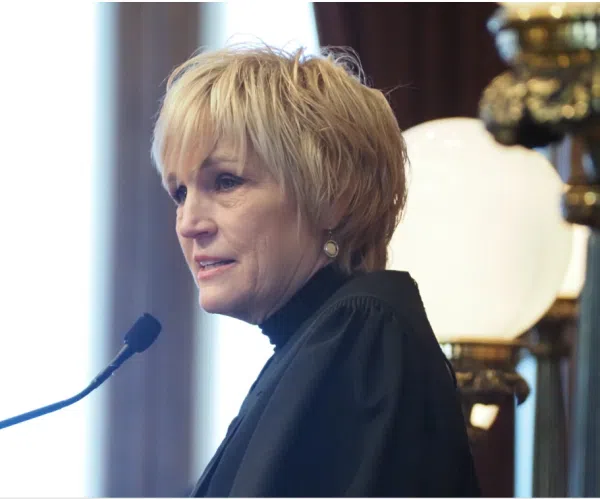
(Iowa Capital Dispatch Story writtenby Robin Ospah, Photo by Robin Opsahl/Iowa Capital Dispatch)
(Des Moines) Iowa Supreme Court Chief Justice Susan Christensen asked state lawmakers for support Wednesday in making “difficult” changes to the state judicial branch’s magistrate system and employee compensation structure.
She spoke to a joint session of the Legislature in her annual Condition of the Judiciary address.
Christensen said that as she prepared for her remarks ahead of the 2026 legislative session, there was one central theme she wanted to highlight: Leadership. In the past year, she said she spoke with leaders in the state executive and legislative branches about the issues facing the judicial branch and the challenges they faced as leaders in Iowa.
“Across every conversation, the message was unmistakable, ‘do what you believe is right, even when it is not popular, and when difficult decisions must be made, explain yourself,'” Christensen said. “That is what I will do today.”
Christensen shared a change made in the state judicial branch in the summer of 2025 — changes to the employment classification and compensation structure. She said the state court administration, working with a consultant, reexamined how the more than 1,500 workers are defined and paid in the current system and made changes which “sparked a lot of grumbling” throughout the system.
The review found that, while overall compensation was competitive for most positions, roughly a quarter of judicial staff were underpaid compared to comparable government jobs, and approximately 10% were paid at or above what data show their job and duties warrant. Based on these assessments and recommendations made by the consultant, Christiansen said the system reduced job classifications from 140 to 82, standardized pay grades, and raised the minimum salary for the 25% of jobs evaluated as underpaid.
However, these changes were not universally popular.
“Change can be uncomfortable, and for some it feels personal,” Christensen said. “But we could no longer ignore a long-standing pay practice that unintentionally favored some while others, often just as dedicated, were underpaid for years. That is difficult to sustain, particularly in a publicly funded system.”
The changes made to the system’s job classification and compensation structure caused both positive impacts — “almost overnight, the number of applicants for judicial branch positions soared,” Christensen said — as well as negative impacts, as many longtime employees were “deeply disappointed by shortened pay ranges or the loss of automatic reclassification based on years of service.”
“We need to work on that,” Christensen said. “Experienced staff is just as important as recruiting new talent.”
The judicial branch is requesting $1 million to address salary compression caused by the recent restructuring, saying this funding will allow the judicial system to pay long-term branch employees more equitably and competitively.
The chief justice said the second “monumental decision” the court system took on in the past year was the modernization of Iowa’s magistrate system.
Christensen also highlighted the need to change Iowa’s magistrate system in her 2025 address. Magistrates are the part-time judicial officials with the authority to conduct preliminary hearings and issue search warrants. Serving the county they reside in or a neighboring county, these officials, who serve four-year terms, preside over cases including simple misdemeanors, evictions, small claims, and involuntary commitment proceedings. For most defendants, a magistrate is the first judicial officer a defendant will see, Christensen said.
While magistrates play an essential role in Iowa’s judicial system, Christensen said the branch was proposing to reduce the number of required magistrates in the state system. Current Iowa statute requires 206 magistrates statewide, she said, a provision the judicial system proposes eliminating, along with the requirement that each county have at least one magistrate.
“Today, it no longer reflects the workload reality,” Christensen said. “In fact, we have perhaps 60 more magistrates than the work requires. That is not sustainable.”
Currently in Iowa, these officers, appointed to serve four-year terms, are expected to devote roughly a third of their professional time to the judicial branch and are free to practice law or earn additional income through other employment during the other two-thirds of their workweek. Because of that division, magistrates are paid $46,611 a year — 31% of the pay a judge, who is required to serve on a bench full-time and cannot practice law.
However, she said, this pay structure does not make sense, as the workload currently required of magistrates under Iowa law “means we are paying nearly $600,000 each year in salary and benefit costs for work that does not equal one full-time position.”
The judicial branch’s proposal would assign magistrates to judicial districts rather than counties. It would allow the state court administration to determine how many magistrates are needed in each judicial district and subdistrict based on a county’s case filings and recent time studies. It would also increase the devoted workload for magistrates from one-third of their work week to 40%, or two days, she said. These changes, modeled after the state’s system for trial court judges, would allow the state to address the needs of Iowa courts more effectively, Christensen said.
“Change is never easy,” Christensen said. “But I am confident this is the right step for our courts. With your support, we can streamline and right-size the magistrate system, improve how the work is administered, and save a minimum of $2.5 million annually for the judicial branch.”
The changes to Iowa’s magistrate system were not the only issue Christensen repeated from previous years’ addresses. She said the problems of judicial pay and indigent defense “remain unresolved” in the state, and will cause problems if not addressed.
“I am committed to bringing up these issues until we move beyond discussion and see meaningful progress,” she said.
Low judicial pay in Iowa is leading to fewer applicants for judicial openings across the state, she said, thereby reducing the quality of applicants for essential roles. She pointed to a district court judge opening in April 2025 for District 8A in southeast Iowa, where only two attorneys applied to fill the position.
“Keep in mind, the job of a judicial nominating commission is to review all applicants and send the two most qualified candidates to the governor,” Christensen said. “But when there are only two applicants, it’s a guarantee both are going to the governor, regardless of their resumes, regardless of experience, regardless of temperament.”
She said Iowa is a “whisper away” from having openings where only one applicant applies to fill a position, stripping a judicial nominating commission or the governor of the ability to meaningfully evaluate whether a person is well-suited to fill the position.
Christensen said the state was requesting an increase in pay for judicial officers of at least 4.3% in fiscal year 2027 to cover the cost-of-living growth and recover “at least a portion of the purchasing power judges have lost in recent years.” The funding would result in a total increase of $2,256,477 for judicial officer salaries, according to the state court administration.
This is a decreased request from last year’s proposal, which sought to link district court judges’ salaries to 75% of a federal judge’s salary. This proposal would have amounted to a 10.2% pay increase, she said.
“We recognize that would be a big step in a single year, but couldn’t we begin to close the gap?”
She also said while indigent defense pay is not a part of the judicial branch’s budget, the underfunding of contract attorneys providing indigent defense “has a profound impact on our courts.” She called for the Legislature to take action on this issue, saying, “Like judicial pay, this isn’t tomorrow’s problem, it’s today’s reality.”
As an example, she brought up a June 1, 2025, criminal complaint in Davenport where a man, who had a prior Operating While Intoxicated conviction and was driving without a license, was arrested for driving the wrong direction on a one-way street by an officer who noted slow, slurred speech and open containers of beer and whiskey in the vehicle. After being arrested, the defendant requested and qualified for court-appointed counsel, but no attorneys were available. After 2.5 months, without the appointment of an attorney, his case was dismissed.
“Could this happen in an OWI case that ended up killing someone? Or a sexual abuse case involving a child? Of course it could,” Christensen said. “If we cannot hold criminal defendants accountable, Iowans are at risk. We are playing with fire.”