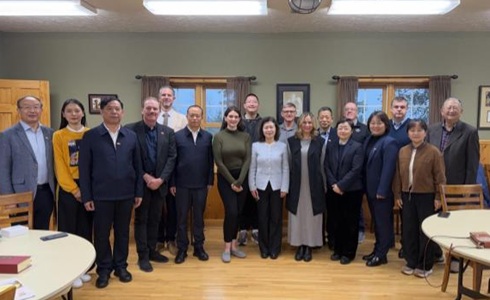
(Orient, IA) More than 80 years after the former U.S. Vice President Henry A. Wallace brought melon seeds to China’s Gansu Province, the Wallace Centers of Iowa welcomed a delegation of Chinese agricultural, academic, and civic leaders to the historic Wallace Farm in Orient on Thursday, October 15th, to celebrate the lasting agricultural legacy of that gift. The visit honored the success of the Bailan melon, which became a beloved crop in the region, while exploring opportunities to build new connections.
A Gift of Seeds That Connected Two Communities
In 1944, during World War II, then-Vice President Henry A. Wallace traveled to China on a diplomatic mission on behalf of President Franklin D. Roosevelt. During his visit, Wallace stopped in Lanzhou, the capital of Gansu Province, where farmers were struggling with drought and repeated crop failures.
The connection to Iowa also involved Dr. Zhang Xinyi, a 1925 graduate of Iowa State College (now Iowa State University), who was serving as director of Gansu Province’s Construction Department. According to historical accounts, Zhang had sought assistance with the region’s agricultural challenges, and an American ecologist suggested that melons might grow successfully in the region’s climate.
Wallace, whose lifelong passion for agriculture and plant breeding shaped his career in public service, brought honeydew melon seeds to China and, according to some accounts, personally delivered them to Zhang during his visit to Lanzhou.
The seeds flourished, and the resulting melon became a popular crop in Gansu Province. Known as the Bailan melon, or White Lanzhou melon, it was also called Hualaishi, a name derived from Wallace, in recognition of the Iowa leader who helped introduce it.
What began as a gesture of goodwill became an enduring symbol of agricultural innovation and friendship between Iowa and Gansu Province.
Honoring the Past, Building Connections for the Future
During the visit, representatives discussed opportunities to strengthen connections through agricultural education, innovation, and cultural exchange.
The gathering also included the planting of a Ginkgo tree at the Wallace Farm, symbolizing the continued friendship between Iowa and Gansu Province and a shared commitment to future collaboration.
“Henry A. Wallace believed that agricultural innovation had the power to improve lives and strengthen communities, and that belief remains central to our work today,” said Rebecca Stavick, Executive Director of the Wallace Centers of Iowa. “While we are proud to preserve the Wallace family’s remarkable history, we are equally committed to carrying that legacy forward. Through our agricultural programs, we continue to explore innovative growing practices and provide fresh, locally grown produce to rural Iowans facing food insecurity. Today’s visit is a wonderful reminder of how a simple act of goodwill can create a lasting impact across generations and borders.”
Continuing the Wallace Agricultural Legacy in Iowa
Today, the Wallace Centers of Iowa continues to grow the historic Wallace melon at its farm near Orient, alongside more than 40 varieties of fruits and vegetables.
Through its Farm to Pantry program and partnerships with local food banks and pantries, the organization provides fresh, locally grown produce to Iowans facing food insecurity, carrying forward the Wallace family’s commitment to agricultural innovation, community service, and improving access to nutritious food.