

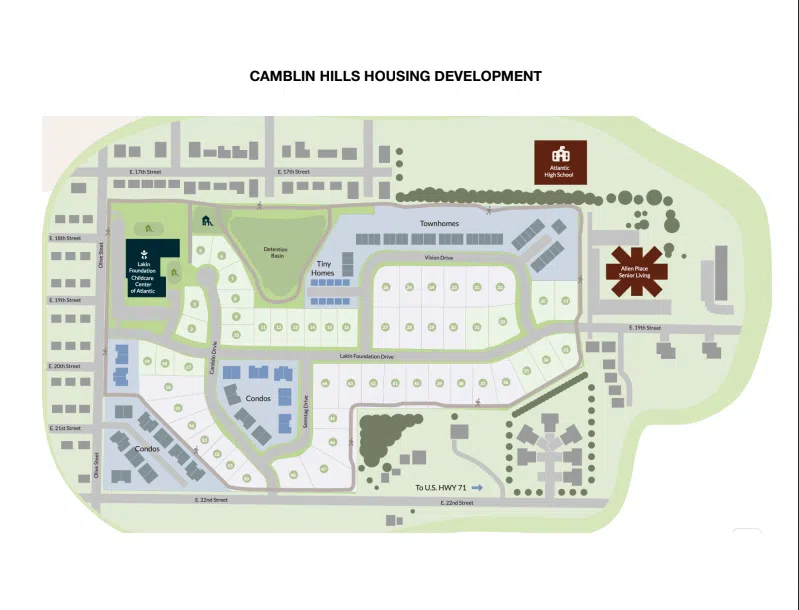
(Atlantic) KSOM/KS95 News continues our series of stories with the Vision Atlantic initiative. This $84 million transformative project includes 142 new housing units, an expansion of the YMCA, and a new childcare development center.
This series offers listeners and readers exclusive behind-the-scenes insight into this groundbreaking effort. This week addresses a donation option for the farming community.
For many cash basis farmers, significant tax savings can be achieved by donating crops out of their inventory directly to Vision Atlantic Inc. Cash charitable contributions are deductible only as an itemized deduction from adjusted gross income. Many farmers do not itemize deductions because the standard deduction has dramatically increased over the years.
Vision Atlantic, Inc. committee member J.C. Van Ginkle says the gift of grain enables a farmer to save money while making a positive impact in their community.
By contributing, cash-basis farmers avoid including the sale of cash crop income. The cash basis farmer can still deduct the cost of the growing crop, which results in saving self-employment tax, federal income tax, and state income tax. Van Ginkle says Vision Atlantic, Inc. needs to raise 80 percent of its goal by the end of this year for the Laken Foundation’s $8.6 million grant to kick in, and the community needs to take advantage of this opportunity.
Vision Atlantic representatives want to make one thing clear. The farmer should always consult with their professional tax or legal advisors to determine tax implications before making the gift. Because of rapid changes in the tax law, information provided here may be outdated.
Meanwhile, the farming community can make a difference by donating grain, providing an opportunity for youth in the community, county, and area. It can save on self-employment tax, federal income tax, and state income tax.
They have the option to deliver grain to their local elevator and request that they provide a warehouse receipt showing Vision Atlantic, Inc. as the owner. Contact Vision Atlantic and let them know where the grain is stored. Vision Atlantic will then order the sale, with the original sales invoice.
To qualify for the highest tax savings, crops must be donated from their inventory. Donation of growing crops triggers taxation for the donor due to the assignment of income rules.
Guidelines:
*Donate crops after they have been harvested.
*Cash basis farmers deduct their growing costs in the year of production. By donating the crop after harvest, the value of the crop is never included in income. However, the production costs are still deductible.
*Instead, the property should be delivered, and a warehouse receipt showing Vision Atlantic, Inc. as the owner should be executed. Vision Atlantic, Inc. then orders the sale of the property with the original sales invoice showing Vision Atlantic, Inc. as the seller.
*The farmer should avoid advising the charity as to when to sell the crops. The IRS may construe this as “retaining control,” advising the charity as to when to sell the crops.
Vision Atlantic will retain in its files:
*Warehouse receipt or a storage ticket in Vision Atlantic, Inc.’s name.
*The original sales invoice showing Vision Atlantic, Inc. as the seller
*If the crops are to be stored on the farm, a notarized letter of transfer can take the place of a warehouse receipt.
After the transfer, Vision Atlantic, Inc. will assume costs of storage, transportation, and marketing, and bear any risk of loss.
The following are tips for making gifts of grain:
*Donate grain grown after the harvest to ensure no triggering of taxation due to assignment of income rules.
*The gifts should be from unsold crop inventory, with no prior sale commitment made before the gift. A farmer will gift the grain to Vision Atlantic, Inc. and let them decide what to do with it and when to sell it.
*Be sure the gift is farm commodities, not warehouse receipts, which could be considered a cash equivalent. Vision Atlantic, Inc. must be able to demonstrate “control and dominion” over the gifted property.
*The farmer should provide no guidance in the transfer agreement as to the retention or sale of the gifted commodity.
*The documentation of either a properly executed warehouse receipt in Vision Atlantic, Inc.’s name, or a notarized letter of transfer for crops stored on the farm. The original sales invoice should list Vision Atlantic, Inc. as the seller.
Another note, following the transfer, Vision Atlantic, Inc. will assume the costs of storage, marketing, and transportation.
If you have any questions, please feel free to contact any Vision Atlantic Committee Member. The gift foundation forms are available by contacting Ted Robinson at the First Whitney Bank.
Vision Atlantic is a 5019(c)(3) organization whose mission is to empower growth, enhance lives, and create a thriving community together through the economic development of Atlantic, Iowa.