


Iowa is home to 13 wild turtle species, nearly all of which are in need of conservation action, or are endangered due to a loss of habitat and road-related mortalities, according to the Iowa Department of Natural Resources.
Iowans can learn about these turtles and how to help conserve the aquatic and semi-aquatic reptiles during Wild Turtle Week, June 9-13.
Turtles of Iowa
The eastern spiny softshell turtle, which is found throughout Iowa and the central portion of the country, lives mostly in the water and utilizes a method of absorbing oxygen through their skin and throat that is sometimes called “butt breathing” according to Partners in Amphibian and Reptile Conservation, or PARC.
Per their name, the turtles do not have a hard shell and rely on their speed for protection. PARC suggests leaving these long-necked and snouted turtles alone if spotted out of the water, as they might be laying eggs.
Snapping turtles are also easily recognizable by their long spiny tails, shells and big, sharp beaks. Certain species of snapping turtle are listed as threatened by the U.S. Fish and Wildlife service which identified habitat loss, commercial and recreational fishing and nest predation as factors contributing to the population decline.
Wood turtles and yellow mud turtles are both listed as endangered in Iowa due to habitat loss and water pollution. Ornate box turtles, and eastern musk turtles are listed as threatened, along with the Blanding’s turtle.
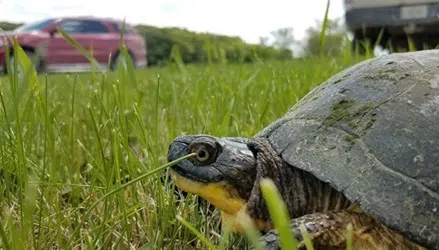
DNR partnered with Blank Park Zoo and Iowa State University to raise and release nearly 60 Blanding’s turtles back into the Iowa landscape. The group released the turtles into the wild June 4.
According to U.S. FWS, these turtles can live for up to 70 years and often travel great distances, which exposes them to dangerous road crossings.
The western painted turtle, found across the state, is known for its bright red, yellow and black colored undersides. This small turtle, along with the red-eared slider, are two turtles that DNR said are not in need of conservation action.
Save the turtles
Iowans can help turtles by avoiding them in roadways, and when possible, stopping to help move them across the roads. DNR said to always move turtles the same direction they were headed when helping them across a street.
It’s also important to never pick up a turtle by its tail, as this can damage the reptile’s spine. A press release from DNR said wetland, grassland and forest preservation can also help to save turtle habitat in Iowa.
Iowans with a keen eye for turtle identification can submit their observations online to Reptiles and Amphibians of Iowa, which charts species populations across the state. The website also has valuable photos and information to help identify turtle varieties.
PARC encourages folks across country to celebrate wild turtle week by sharing their turtle photos on social media with #ShellebrateTurtles. The organization also has webinars and other online resources with lots of turtle facts.
Blanding’s turtle is a threatened species in Iowa. (Photo by Iowa DNR)