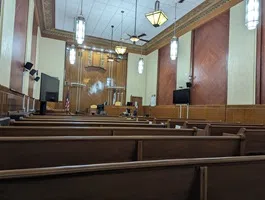
(Atlantic) The Atlantic City Council on Wednesday will hold a public hearing and first reading of an ordinance amending “Stand-Alone Garages.”
The Planning and Zoning Commission has been working on the proposed Stand-Alone Garage Article since April. During its August 11 meeting, members unanimously approved the drafted language, which would be added to Atlantic’s Zoning Ordinance.
The proposal is intended to address several issues identified by the commission, including residents’ need for additional storage space, Atlantic’s taxable valuation relative to peer communities, and the number of vacant infill lots that produce little or no tax revenue yet still require city resources for maintenance.
The commission noted that demand for conventional infill housing is weak in some areas, leaving vacant residential lots sitting idle. Some of those lots may also be economically difficult to develop for housing because of surrounding property values.
Under Atlantic’s current zoning ordinance, a garage is considered an accessory building and must be subordinate to and located on the same lot or group of lots as the main building. That means a garage cannot currently be constructed on a vacant lot.
The proposed policy would create a more specific framework for allowing stand-alone garages on qualifying lots. The concept was based largely on the R-G Residential Garage District in Watertown, South Dakota.
Commission members said the proposal could meet existing market demand while improving the maintenance and appearance of vacant lots. It could also incrementally increase property valuations compared with leaving lots vacant.
Another potential benefit identified by the commission is that the approach could provide an alternative to more costly neighborhood-clearing efforts or to subsidized infill housing in areas where the market does not currently support new homes.
However, the commission also considered potential drawbacks.
One concern is that allowing garages could establish a lower-intensity use on lots that might eventually be suitable for housing. The commission’s response is that the proposed policy includes a maximum lot size, thereby preventing the concept from being applied to an excessively large tract of land.
Another concern is the possibility of nuisance issues involving outdoor storage, hobby businesses, vehicle repair, noise, appearance, stormwater, and de facto habitation.
Commission members said those concerns were specifically considered while developing and refining the proposed regulations, with the goal of preventing those uses and problems.
The commission also discussed whether stand-alone garages would provide enough additional tax revenue to justify the policy. Members acknowledged the fiscal gains could be modest, but argued that generating some property value from currently vacant land is preferable to having adjacent land generate little or no revenue while the city continues to maintain existing infrastructure and surrounding property.
The proposed Stand-Alone Garage Article now moves forward through the city’s zoning process.
The meeting starts at 5:30 p.m. in the City Council Chambers at City Hall.