


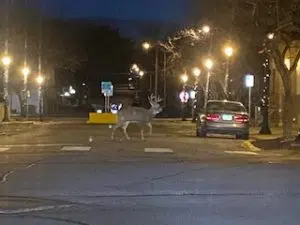
(Des Moines) While deer-vehicle collisions occur year-round, deer movement increases during the breeding season, peaking around the first week of November. Combined with crops coming out and shorter daylight hours, that adds up to more deer-vehicle collisions.
“Deer like to travel at dawn and dusk, and with the shortening daylight hours, that puts a lot of commuters on the road when deer could be on the move,” said Jim Coffey, forest wildlife research biologist with the Iowa Department of Natural Resources. “As we enter the prime breeding time, deer move more throughout all hours of the day. This time of year, we encourage drivers to reduce their speeds, give additional space between vehicles, which will give drivers more time to react, and slow down to avoid a crash.”
Deer tend to travel in groups during the rut, Coffey said, and drivers should try to avoid focusing on the first deer they see because there may be another one coming behind it.
“Drivers who encounter a deer on the road, and a collision is inevitable, are encouraged to stay in their lane, brake, and try to control the impact,” he said. “While hitting a deer can be a tragic event, much more harm may occur by swerving to avoid the collision than by simply hitting the deer.”
Iowa’s deer population isn’t distributed equally across the state, but more often associated with timber habitat and river corridors. When passing through these areas, drivers should be aware of their surroundings, slow their speed, and watch for deer from fencerow to fencerow.
State law allows people who hit a deer to take the meat under a salvage tag. Contact the local sheriff’s office to get a tag. The caveat is the whole animal must be taken – it is illegal to take the antlers.