(Iowa Capital Dispatch) Iowa House lawmakers passed the state’s per-pupil funding package Thursday for K-12 schools, amending the measure to a 2% rate that House Republicans said was a “compromise” reached between the legislative chambers and Gov. Kim Reynolds.
The 2% State Supplemental Aid proposal in the amended Senate File 2201 is in line with Reynolds’ initial proposal, but it is higher than the Senate GOP’s initial 1.75% SSA rate and lower than the House GOP’s proposed 2.25% rate.
It is also significantly lower than the 5% rate requested by educators and advocate groups including the Iowa State Education Association and Iowa Citizens for Community Improvement.
In addition to setting the SSA rate, the measure also incorporates several other funding components, including the extension of property tax relief payments by a year. It provides an estimated $42.2 million state funding for schools placed on the budget guarantee — the system allowing school districts to increase property taxes if they cannot meet funding obligations under the state’s per-pupil funding rate.
Additionally, the bill provides $7 million for paraeducator and support personnel pay — half of the $14 million requested by the House GOP in their initial education funding proposal.
The bill also caps transportation equity payments at $1 million while providing a 2% increase for funding, and has student counts for schools occur twice per school year, with enrollment numbers taking an average between these two counts.
Rep. Dan Gehlbach, R-Urbandale, said the bill would amount to a state cost per pupil of $8,148 — a $160 increase per student from the previous fiscal year.
“Altogether, this appropriates $105.9 million more dollars,” Gehlbach said. “When taking the 2% SSA, the budget guarantee pickup, and $7 million paraeducator pay altogether, this would amount to a 2.7% general fund increase from the prior fiscal year.”
But Democrats argued this funding amount was not enough. Rep. Heather Matson, D-Ankeny, introduced an amendment calling for a 5% SSA rate, which she said was the minimum amount necessary to allow schools to keep up with the rate of inflation while not having to consider potential cuts to services. The measure would have also provided the full $14 million original requested by House Republicans for paraeducator and education support staff pay.
Matson said Iowa House Democrats are focused on ways “to make Iowa number one in education again,” and said the amendment would help Iowa students and teachers by giving schools the means to maintain smaller class sizes and keep elective course options available.
“This is about priorities, and in this building, I know that where there’s a will, there’s a way,” Matson said. “Iowa was number one when we believed in abundance, not forced austerity, in public education for all our kids as a common, good, foundation of our success as a state, not education as an individualized free market purchase for each family. I know I am not alone in wanting Iowa to be number one in education again. This amendment is a step in helping us to get there.”
The amendment failed in a 30-63 vote. Gehlbach said the Democrats’ proposal would add $126 million to the state’s general fund budget.
“I respectfully ask the minority party where these funds will be coming from, which budgets would they be cutting to get this money, or what taxes would they increase?” Gehlbach said. “This proposal we have coming is agreed to with our Senate counterparts and the governor, and we’re ready to make sure this number is set, and our districts have the certainty moving forward as they set their budgets this budget season.”
Matson responded that House Democrats “believe that the money is there to make those investments, but again, it’s about priorities.”
She and other House Democrats said Republicans’ proposal shows that they are not prioritizing Iowa’s public K-12 school system. Matson said some Republicans are asking “how much is enough” for school funding. She said if the Legislature was providing “enough,” many of the funding problems seen at Iowa school districts would not be happening, such as the Boone Community School District’s decision to end its 100-year-old orchestra program because of lower state funding and declining enrollment. That issue was also brought up during Senate debate on the bill.
But she said Boone was not alone. In Urbandale, she said the school district is considering 21 full-time job cuts and music program reductions as it faces a $1.5 million deficit, and in Fort Madison, the school board is weighing an increase in property taxes.
“For me, ‘enough’ would be Ankeny not having to cut more than $5 million over the next four years,” Matson said. ” I’m told these cuts could come in the form of reducing elective course offerings at the secondary level, increasing elementary class sizes and reducing district staffing. And look, when Ankeny — a growing district that budgets, I will say, very conservatively — is facing cuts in the millions, you know something is really wrong.”
Rep. Josh Turek, D-Council Bluffs, said the 2% SSA rate was “entirely insufficient.” He said Republicans who argue the measure is increasing funding for Iowa’s public school systems are misrepresenting the proposal, which he said does not keep up with inflation.
“We hear that we are spending the most that we’ve ever spent on public education, but that completely ignores what every single Iowa knows — every single thing is more expensive, and this funding increase doesn’t even keep up with inflation,” Turek said. “Our public schools, they’re tired of this act. Struggling families and communities across Iowa, they’re also tired of this act. We must stop insulting Iowans’ intelligence by ignoring inflation.”
Because Iowa has not kept up with rising costs for multiple years, the state is now spending “$1,200 less than the national average per pupil, and this is why we have fallen from number one in public education to the middle of the pack,” Turek said.
Gehlbach said the state is providing a total of almost $4 billion in funding, “the largest single appropriation we will make this year as a state” — in addition to emphasizing public schools are also funded through a variety of other sources.
“While that is a massive commitment of over 40% of our state general fund, it’s only part of the total funding for our public schools,” Gehlbach said. “This isn’t the whole story. When you factor in local property taxes … you add on all federal funds and the ‘Save Penny,’ which is the 1% sales tax for school infrastructure, our schools are operating with a total resources exceeding $11 billion annually.”
He said as Iowa schools face declining enrollment, the 2% SSA rate builds on “$24,000 and climbing” total per-pupil spending for Iowa students.
“This bill delivers over $100 million in new monies to our schools — even as enrollment continues to decline statewide with certified public enrollment down another 1.5% this year alone, to about 473,000 students,” Gehlbach said. “We’re serving fewer kids overall. That demographic reality, driven by lower birth rates, means fixed costs are spread across a smaller base, naturally boosting dollars remaining per student in the classroom.”
The measure passed the House 58-35 and returns to the Senate. If approved, the education funding bill will go to the governor’s desk.
House Speaker Pat Grassley said House Republicans were focused on moving forward a school funding package quickly to provide school districts certainty about funding for the upcoming year as they begin the budgeting process. However, he said, the caucus plans to continue to pursue an additional $7 million in funding for paraeducator and support personnel pay later in the appropriations process.
He said this is an improvement from negotiations during the 2025 session, when House Republicans sparred with the governor and Senate GOP lawmakers on providing this $14 million in funding, which ultimately came from the state’s Sports Wagering Fund.
“This isn’t the House just saying we’re stopping at $7 million,” Grassley said. “We’re going to continue to continue to push for it. We wanted to get it locked in right now as much as we could, because we came into this wanting as much as possible.”
The Legislature’s self-imposed deadline to pass the education funding package within 30 days of the governor’s budget being released passed on Feb. 12. Senate Majority Leader Mike Klimesh said there was a “very high likelihood” the bill would move in the Senate next week.
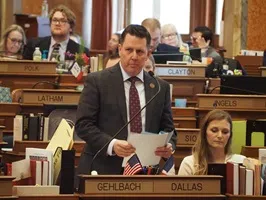
Rep. Dan Gehlbach, R-Urbandale, was the floor manager for the bill setting the State Supplemental Aid rate providing per-pupil funding for the 2026-2027 school year. (Photo by Robin Opsahl/Iowa Capital Dispatch)